
Overview
At the same time, this work is deeply connected to people. Healthy catchments mean more reliable water. Functioning ecosystems support livelihoods. Resilient landscapes are better able to withstand drought, fire and climate pressure.
By working alongside landowners, communities, traditional authorities and conservation partners, the team brings together scientific knowledge and local experience to guide practical, long-term solutions. From on-the-ground restoration to monitoring and learning, the aim is simple: to ensure that the natural systems we all depend on remain strong, connected and able to sustain life across the region.
Across the Kruger to Canyons Biosphere Region, the health of the land shapes everything. It determines how water flows through our catchments, how ecosystems support wildlife, and how communities are able to live, farm and thrive.
The Catchment and Conservation Team works to protect and restore this ecological foundation.
Working across rivers, rangelands and protected areas, the team focuses on keeping natural systems functioning as they should. This includes restoring degraded landscapes, clearing invasive plants, strengthening conservation corridors, and supporting the expansion and effective management of protected areas.
Catchments in the K2C
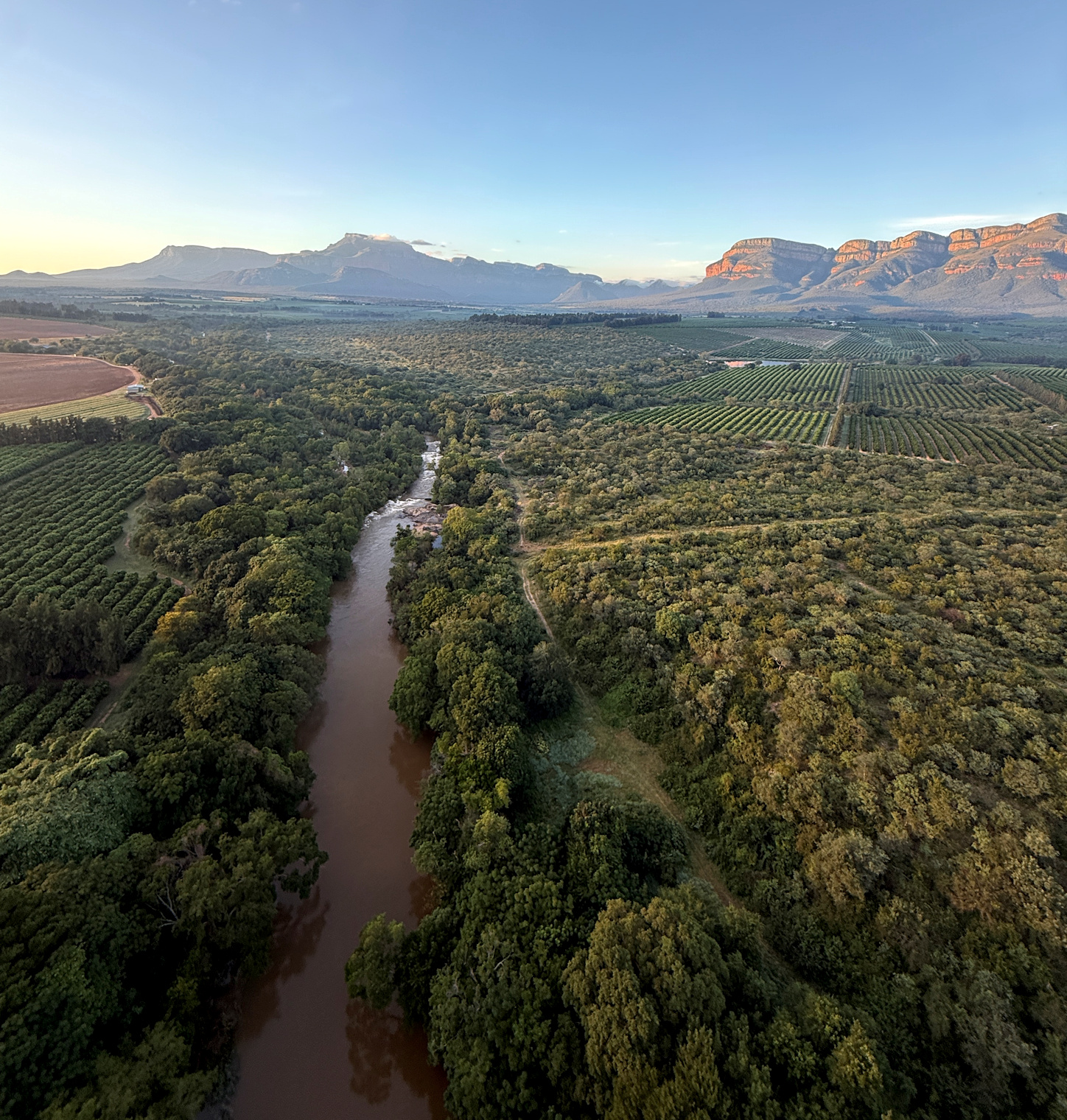
The K2C Biosphere covers several important river catchments / watersheds. These catchments form part of the greater Olifants and Inkomati-Usuthu Water Management Areas and include the Blyde, Klaserie, Selati, Letaba, Sabie and Sand River Catchments. The upper reaches of these catchments receive very high rainfall ranging from 1000-2000 mm per year. As a result, the upper sections of these catchments make up the majority of two major Strategic Water Source Areas (SWSA) for both surface and groundwater.
Key Facts
 Location
Blyde, Klaserie, Selati, Letaba, Sabie and Sand River Catchments, Limpopo
 Area covered
Blyde, Klaserie, Selati, Letaba, Sabie and Sand River Catchments, Limpopo
 Focus
Focus
Invasive alien plant removal, rangeland management, conservation corridors, OECMs

Partners
The Nature Conservancy, Nature for Water, OneTree Planted, SAEON, AWARD, Global Water Challenge, MTPA
 Contribution to K2C Strategic Priorities:
Revenue generation & Sustainable Financing (SP1); Partnerships (SP2); CIP (SP3); Production Landscape (SP4); Community Enterprises (SP5); Policy Influence (SP6) Knowledge Management (SP 7).
Projects
Upper Letaba Restoration Project
Between March 2024 and February 2026, the Upper Letaba Catchment Restoration Project transformed the landscape of the Upper Groot Letaba catchment while strengthening partnerships, creating jobs, and securing vital water resources for the region. What began as an invasive alien plant clearing initiative evolved into a landscape-scale restoration effort that is now helping to catalyse long-term stewardship, scientific research, and community collaboration across the Wolkberg escarpment.
> 720 million litres
Water returned to system each year
1,646 hectares
Land restored through invasive alien plant removal
40 jobs
Green jobs created
100+ people
Student & volunteer participation
18
Women employed
20
Youth employed
4 accredited training types
Chainsaw operation, fire awareness, snake safety, personal finance
Support from The Nature Conservancy (TNC), the Global Water Challenge (GWC), and Coca-Cola Beverages South Africa (CCBSA), and local NGO Mountain Environmental Watch (MEW) made this work possible.
Catchment Investment Programme
The K2C Catchment Investment Programme (CIP) is a coordinated, long-term initiative to safeguard South Africa’s Blyde River Catchment.
It integrates nature-based solutions, sustainable land management, and community participation to ensure water security and biodiversity protection.
AFR 100
The AFR100 initiative has been implemented since July 2022 in partnership with Conservation South Africa (CSA).The aim of this project is to restore 600ha of degraded land by clearing Alien Invasive plants in order to promote natural regeneration of indigenous vegetation.
The secondary goal of the AFR100 project is to explore potential value chain opportunities such as such as using the Alien Invasive off-cuts to produce biochar, wood vinegar and wood chips which will support the establishment of SMME’s to empower communities adjacent the Protected Area.
30 jobs
Green jobs created
Conservation Corridors & OECMs
This initiative works to secure and improve management of key biodiversity and water corridors linking the Greater Kruger to the escarpment and Blyde River Canyon Nature Reserve. These corridors will secure critical riparian habitats which provide breeding grounds and migratory routes between the Lowveld and the escarpment for various threatened species.
Through this project, properties will be better secured through various biodiversity stewardship mechanisms such as the formal declaration of protected areas (nature reserves or protected environments) or more flexible conservation agreements (OECMs).
3584,22 hectares
Malachite Nature Reserve declared for conservation
5445 hectares
Potential OECMS assessed
Various organisations within the landscape are implementing projects to protect and secure ecological infrastructure to improve water security in the region.
This interactive map indicates where catchment partners are working.
Catchment Partners


resources
 Various reports from


GALLERY


Get in Touch
Nicholas Theron
Programme Manager